
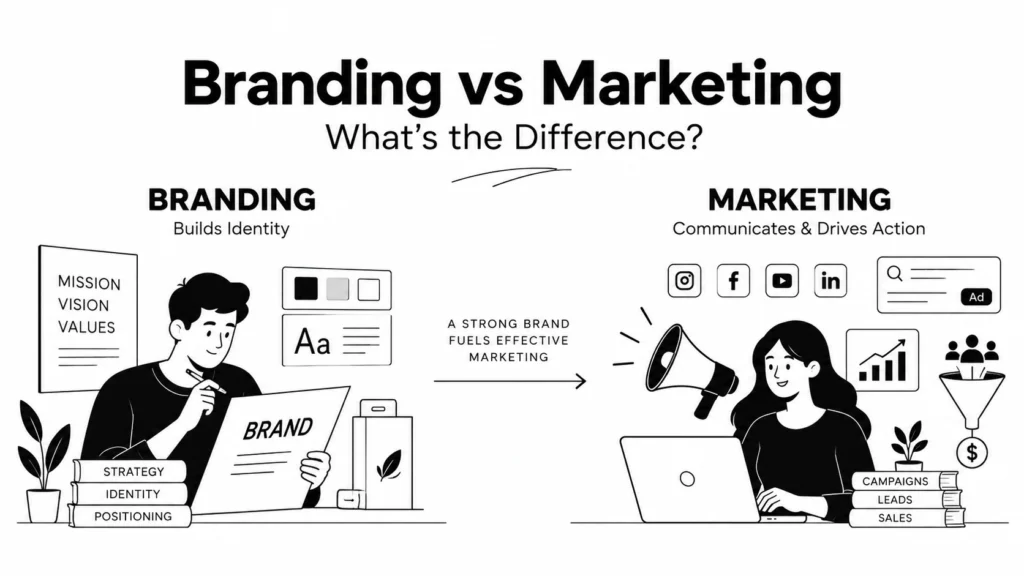
Branding vs Marketing: What’s the Difference?
Branding and marketing are frequently treated as if they are the same, but in fact they are not. Although both of them are important for business growth, they have different purposes.
Branding tells us who your business is, whereas marketing passes on that identity to your target audience and gets them to take action. To put it simply, branding is what helps to build recognition, trust, and loyalty, and marketing is what helps to create awareness, generate leads, and boost sales.
If a business understands the difference between branding and marketing it will be able to build a stronger identity at the same time as drawing up more effective marketing strategies.
What Is Branding?
Branding is the process of determining how people perceive and remember your business; it involves much more than just a logo or a colour scheme, since your brand consists of all the factors that shape how customers perceive your company.
Branding can include:
• Company name and logo
• Colours, fonts, and visual identity
• Mission, vision, and values
• Brand personality and tone of voice
• Customer experience
• Positioning and reputation
For instance, a premium fashion brand might employ attractive visuals, refined language, and exclusive customer experiences in order to convey an image of luxury and quality.
Branding answers questions such as:
• Who are we?
• What do we stand for?
• Who are we serving?
• Why should customers choose us?
• How do we want our customers to feel towards our business?
In this sense, branding is the long-term promise a business makes to its customers.
What Is Marketing?
Marketing refers to the strategies and activities that a business employs in order to promote its products or services, identify potential customers, communicate the value they offer, and prompt them to take action.
Common marketing activities include:
• Search Engine Optimization (SEO)
• Social media marketing
• Paid advertising
• Content marketing
• Public relations
• Lead-generation campaigns
Unlike branding, marketing is often more flexible and campaign-focused. Businesses can change their marketing messages, platforms, offers, and campaigns based on their target audience, budget, objectives, and market conditions.
Marketing answers questions such as:
• How can we reach our target audience?
• Which marketing channels should we use?
• What message will attract attention?
• How can we generate leads or sales?
• How should we measure our results?
Branding Is the Foundation of Marketing
Marketing becomes more successful when it is supported by clear and consistent branding.
Suppose you come across two adverts put out by the same firm. One of them has a serious tone and employs completely different colours, whereas the other is humorous and makes use of a visual style that has nothing to do with the first. Even if both adverts are well designed, the company might seem inconsistent or hard to remember.
A well-defined brand helps maintain consistency across:
• Website
• Social media
• Advertisements
• Packaging
• Email communication
• Customer service
This consistency helps customers easily recognize our business and understand what to expect from it.
Marketing Brings the Brand to Life
Branding defines who we are as a company, while marketing is how we share that identity with our audience.
For example, imagine a skincare company positioned around sustainability and natural products. Its branding could use natural colours, sustainable packaging, and messaging focused on responsible production.
Its marketing strategy could include:
• Blog posts about eco-friendly skincare
• Social media content about sustainable habits
• Search ads targeting people looking for natural skincare
• Email campaigns promoting sustainable products
• Collaborations with environmental creators
The branding sets the company’s identity, and marketing is the way that identity is communicated to potential customers.
An Easy Example
Consider a coffee company called Morning Leaf Coffee.
Its branding might communicate:
• Freshness and simplicity
• Ethically sourced coffee
• A friendly personality
• Environmentally friendly packaging
• Warm and welcoming colours
Its marketing could include:
• Instagram videos showing how the coffee is prepared
• Google Ads targeting local coffee customers
• Email campaigns designed to encourage customer loyalty
• Limited-time discounts for new customers
• Blog articles about coffee preparation
Here, branding creates the identity and emotional connection, while marketing attracts attention and encourages people to visit the store or place an order.
How Branding and Marketing Work Together
Branding and marketing are most effective when they work together.A strong brand enhances marketing efforts by making them more recognizable and convincing, as customers can easily remember and connect with the business.On the other hand, marketing reinforces the brand by consistently presenting its message, visual elements, and core values to the audience.
Businesses can align branding and marketing by:
• Keeping the core message consistent across channels
• Maintaining a consistent visual identity
• Making sure promotions reflect brand values
• Creating content that educates, helps, or entertains the audience
• Measuring both short-term marketing performance and long-term brand growth
• Ensuring the actual customer experience matches the brand promise
Common Branding and Marketing Mistakes
Treating Branding as Just a Logo
A logo is only one part of branding. A complete brand also includes reputation, customer experience, communication style, values, and market positioning.
Focusing Only on Short-Term Sales
Marketing campaigns can generate immediate results, but businesses that ignore branding may struggle to build long-term customer loyalty and differentiation.
Changing the Brand Too Often
Marketing campaigns and messages can change regularly. However, constantly changing the core brand identity can make a business difficult for customers to recognise and remember.
Running Marketing Campaigns Without a Clear Audience
Even a well-designed campaign can fail if it targets the wrong people. Businesses need to understand who they are serving and why their offer matters to that audience.
Making Promises the Business Cannot Deliver
A brand promise must match the actual customer experience. If a business promotes excellent customer service but consistentlyprovides poor support or experiencesdelays, customer trust can decline.
How to Measure Branding and Marketing
Branding and marketing require different types of measurement.
Branding metrics can include:
• Brand awareness
• Brand recall
• Customer perception
• Customer loyalty
• Repeat purchases
• Preference over competitors
• Online reviews and reputation
Marketing metrics can include:
• Website traffic
• Search rankings
• Social media engagement
• Email open and click-through rates
• Leads generated
• Conversion rate
• Customer acquisition cost
• Return on advertising spend
• Revenue
Marketing performance can often be measured relatively quickly, while branding results usually develop through repeated interactions with customers over a longer period.
Final Thoughts
Branding and marketing are not competing concepts. They are two connected parts of a successful business growth strategy.
Branding defines who you are, while marketing communicates who you are to the right audience.
Branding builds recognition, trust, loyalty, and differentiation. Marketing uses channels and campaigns to attract attention, generate leads, and drive sales.
A business that combines a strong brand with effective marketing can achieve short-term business results while building a stronger reputation and customer relationship for the future.
Frequently Asked Questions
1. What is the difference between brand and marketing?
Branding is the act of crafting and managing the identity and image of a business. Marketing is about getting the business, getting the customers in.
2. Is branding greater than marketing?
Neither is more important, per se. Branding is the foundation. Marketing is letting the target audience know about that brand and bringing business results.
3. Can you market a business that isn’t branded?
sure, but advertising is inconsistent and forgettable with out a robust logo. an excellent logo makes your advertising and marketing campaigns more cohesive and recognizable.
4. Is branding same as logo?
None Branding is more than simply a logo. Branding is your values, your personality, your way of communicating, your customer experience, your reputation and your place in the market.
5. Which comes first: branding or marketing?
Branding generally comes first because it establishes the identity and positioning that marketing campaigns will communicate.
6. Does branding help increase sales?
Yes, strong branding can contribute to customer trust, recognition, loyalty, and preference, which can support sales and long-term business growth.
7. What are examples of marketing?
SEO, social media marketing, paid advertising, email marketing, content marketing, influencer marketing, public relations, and promotional campaigns are common examples of marketing.
8. How do branding and marketing work together?
Branding establishes what a business stands for and how it should be perceived. Marketing communicates that identity to the target audience through different channels and encourages customers to take action.