
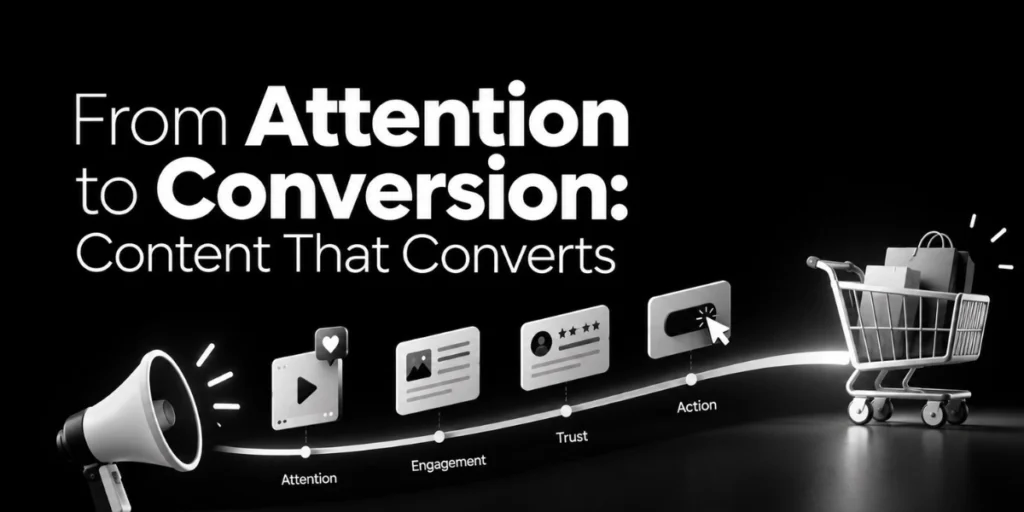
Many businesses post every day. They get likes, views, and shares. But when the month ends, sales are still low. Sound familiar?
The problem is not a lack of attention. The problem is that attention is not the same as action. To grow, you need content that converts: content that helps people trust you, understand your offer, and take the next step.
In this blog, I will share a simple, practical way to move your audience from “just looking” to “ready to buy.” These ideas come from hands-on work in digital marketing with small and growing businesses, where every post must earn its place.
Why Attention Alone Does Not Pay the Bills
A viral post feels great, but it does not always bring customers. People may enjoy your content and still never buy. Why? Because the content did not guide them anywhere.
Think of your content as a road. Attention brings people to the start of the road. Your job is to lead them, step by step, to the end, which is customer conversion.
Start with a Clear Content Marketing Strategy
Before you write anything, ask three questions:
- Who am I helping?
- What problem do they have?
- What should they do next, in my opinion?
A good content marketing strategy answers these first. Without it, you are guessing. Write down your audience, their main worries, and one goal for each piece of content, such as “sign up,” “book a call,” or “buy now.”
Use the Content Marketing Funnel
The content marketing funnel shows how people move from stranger to customer. It has three simple stages:
1. Top of the funnel (awareness). People do not know you yet. Use blog posts, short videos, and social posts that answer common questions. Keep it helpful, not salesy.
2. Middle of the funnel (consideration). People are comparing options. Share case studies, guides, checklists, and email tips. Show that you understand their problem.
3. Bottom of the funnel (decision). People are almost ready. Use testimonials, demos, free consultations, pricing pages, and clear offers.
Many brands only create top-funnel content, so they get attention but few sales. A balanced funnel fixes this.
How to Create Content That Converts
Here is what content that converts usually has in common:
A strong, honest headline. Promise something real. Do not trick people with clickbait. Broken promises destroy trust fast.
One clear message. Every piece of material should serve a single purpose. Too many ideas confuse readers, and confused readers leave.
Real proof. Use customer stories, results, photos, and reviews. Advertisements are not as trustworthy as other people.
A clear call to action (CTA). Tell people what to do next. “Download the free checklist” works better than hoping they will figure it out.
Simple language. Write the way you talk. Short sentences and easy words keep readers moving. This is the heart of conversion-focused content: make it easy to understand and easy to act on.
Build Audience Engagement That Leads to Trust
Audience engagement is more than likes. It means people read, reply, save, share, and come back. To build it:
- Answer comments and messages quickly.
- Ask questions in your posts.
- Share behind-the-scenes moments.
- Use stories from real customers.
When people feel heard, they trust you more. Trust is often the missing piece between a follower and a buyer.
Lead Generation Through Content
On their first visit, not everyone is prepared to make a purchase. That is why lead generation through content matters. Offer something useful in exchange for an email address, such as a checklist, template, mini-guide, or free audit.
Then follow up with helpful emails. Over time, these small touches turn cold visitors into warm leads. This is high-converting content at work: it builds a relationship before it asks for a sale.
Create Content That Drives Sales
Content that drives sales speaks to a buyer’s final doubts. Ask yourself: what stops people from buying? It may be price, trust, timing, or fear of making a mistake. Then create content that answers each worry:
- A “how it works” video for people who feel unsure
- A comparison guide for people who are choosing
- A FAQ section for common doubts
- A money-back promise or free trial, if you can offer one
When you remove doubt, you remove the barrier to buying.
Measure Your Content Conversion Rate
What you do not measure, you cannot improve. Your content conversion rate is the share of visitors who take the action you want. A simple way to calculate it:
Conversions ÷ Visitors × 100
For example, if 500 people read a page and 10 sign up, your conversion rate is 2%.
Track these numbers in tools like Google Analytics or your email platform. Test one change at a time, such as a new headline or a different button. Small tests teach you what your audience likes. Keep in mind that results differ by industry, so compare yourself with your own past results first.
Why Content Marketing for Business Growth Needs Trust
Content marketing for business growth is a long game. It works best when your content shows real experience, clear knowledge, and honest intent. Share what you have learned from real projects. Be open about what you do well and what you do not offer. Update old posts when facts change. Readers and search engines both reward content they can trust.
Final Thoughts
Attention is only the first step. To grow, you need content that converts: content that is built on a clear content marketing strategy, guides people through the funnel, and builds real trust.
Start small. This week, choose one piece of content. Give it one clear goal, one strong proof point, and one simple call to action. Then measure the result and improve it. Do this again and again, and your audience will slowly become customers.
Frequently Asked Questions
1. What is content that converts?
It is content made to move people toward an action, such as buying, signing up, or booking a call, instead of only getting views.
2. How long does it take to see results from conversion-focused content?
It depends on your audience and channels. Many businesses see early signs in a few weeks, but steady growth usually takes a few months of regular effort.
3. What constitutes a decent conversion rate for content?
There is no single number. It changes by industry, offer, and traffic source. Keep an eye on your own rate and strive for gradual improvement.
4. Do I require each of the three phases of the funnel?
Yes, ideally. Top-funnel content brings people in, middle-funnel content builds trust, and bottom-funnel content helps them decide.
5. Can content marketing help small firms expand?
Yes. Even a small business can start with one blog, one social channel, and one email list. Sales will follow if you put your audience’s needs first.