How does branding differ from marketing?
The terms branding and marketing are frequently used by many businesses as though they were identical. However, although they are closely related they also have different purposes.
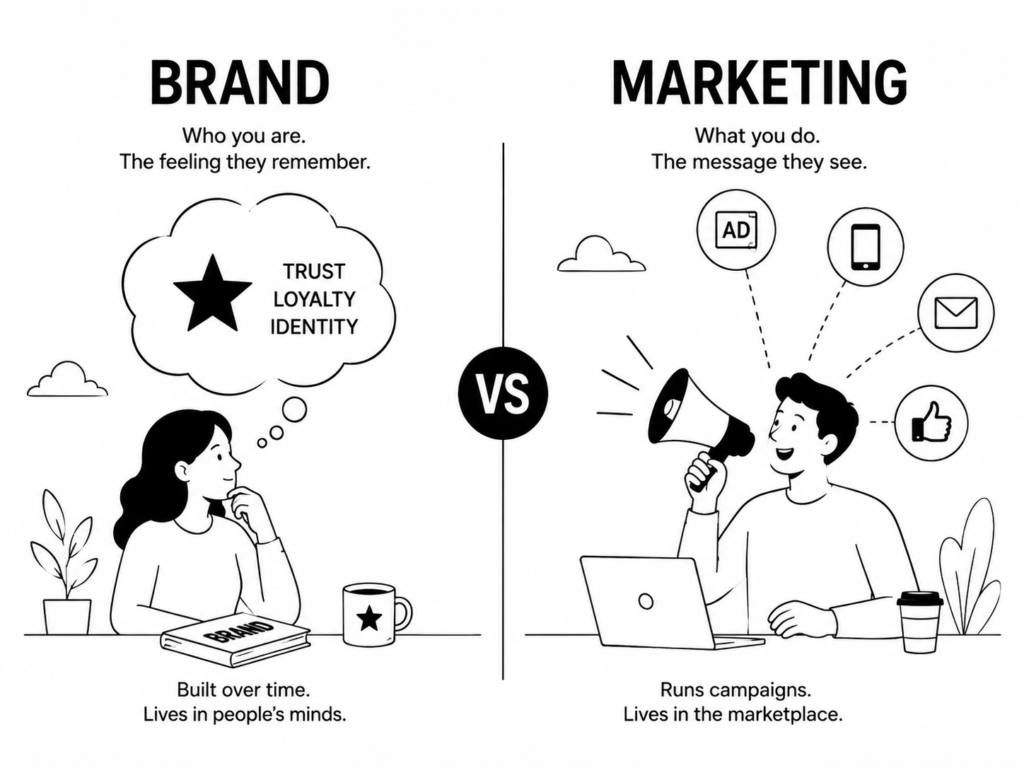
Branding informs us about what your business does, while marketing passes on that identity to your target audience and gets them to take action. In simple terms, branding leads to recognition and trust, whereas marketing results in awareness, leads, and sales.+kantar+1
Brand positioning means setting up and managing the identity of your business and includes all the elements that influence the way people recognize, comprehend and remember your company.
What Is Branding?
Branding can include:
Your company’s name and logo.
The colours, fonts, and visual style of the brand.
• Mission, vision, and values.
— The brand’s personality and its tone of voice.
• Customer experience.
• Positioning and reputation.
The emotions that customers associate with your business.
For example, a premium fashion brand can create an atmosphere of sophistication by using elegant visuals, employing sophisticated language, and providing exclusive experiences, which in turn allows customers to form a clear idea of the company before they make a purchase.
Branding answers questions such as:
• Who are we?
What is our position?
• What sort of people are we serving?
Why should customers choose us?
What kind of feelings do we want people to feel about our business?
In this respect, branding is the long-term promise that a company makes to its customers.
What Is Marketing?
Marketing involves the different strategies and activities which a business uses in order to promote its products or services; the objective is to get hold of potential customers, communicate the value that is being offered, create interest and cause them to take action.
Common marketing activities include:
• Search engine optimization.
• Social media marketing.
• Email campaigns.
• Paid advertising.
• Content marketing.
• Influencer marketing.
• Events and sponsorships.
• Sales promotions.
• Public relations.
• Lead-generation campaigns.
Marketing is more flexible and campaign-focused than branding is. A company is able to change its marketing message, platform, offer, or campaign depending on the audience, the budget, its business objectives, or the market conditions.
Marketing answers questions such as:
• How can we reach our target audience?
Which channels should we select?
Which message will manage to attract attention?
How should one go about generating leads or sales?
• What method shall we use to measure the results?
Branding Is the Foundation of Marketing
If a company is to carry out effective marketing it must have a strong brand, for without clear branding its campaigns could appear to be disconnected, inconsistent or difficult to remember.
Imagine that you come upon two advertisements for the same company. One of them is serious in tone while the other is humorous, and both show completely different colours and messages. The company may then appear to be confusing or untrustworthy even though both advertisements are well designed.
Since you have a well-defined brand, consistency will be maintained in all the ways that customers interact with your business, for example on your website, in your social media profiles, in your advertisements, in your packaging, in your emails, and during your customer service. This consistency allows people to recognise your company and know what to expect from it.
Marketing Brings the Brand to Life
Branding defines the message you want to convey, but it is marketing that ensures it reaches the appropriate people.
For example, a company could adopt the image of being a skincare brand that is environmentally responsible, using natural colours, sustainable packaging, and messages which emphasise responsible production.
Its marketing might then include:
Blog posts about eco-friendly skincare.
Content about eco-friendly habits that appears on social media.
• Search ads directed at individuals who are looking for natural products.
• Run email campaigns for new sustainable products.
– Working together with other people who are involved in environmental matters.
The branding allows the company to have a consistent identity and purpose, while the marketing activities enable it to reach potential customers.
An Easy Example
Suppose there is a coffee company called Morning Leaf Coffee.
Its branding might communicate:
• Freshness and simplicity.
• Ethically sourced coffee.
— He has a pleasant and friendly personality.
• Earth-friendly packaging.
The tones are friendly and the colours are warm.
Its marketing might include:
There are videos on Instagram which show how to make the coffee.
• Targeting local coffee customers using Google Ads.
One that is based on loyalty through the use of an email campaign.
• For a limited time, new customers receive a discount.
There are articles on the blog which deal with the preparation of coffee.
It is the branding that creates the identity and sets up an emotional connection, whereas marketing has the role of attracting attention and getting customers to visit the store or place an order.
How Branding and Marketing Work Together
Branding and marketing function most effectively when they assist each other.
A strong brand can make its marketing more identifiable and persuasive; since customers already trust and remember the company, they will likely respond to its campaigns.
Marketing contributes to the establishment of a brand by making sure that the audience has repeated contacts. Each advertisement, social media posting, email, and customer experience has the ability to either enhance or damage the image of the brand.
To align both areas:
Ensure that all of your marketing channels communicate the same key message.
Ensure that your visual identity stays consistent.
• Ensure that your promotions reflect your brand values.
• Create content in order to educate, assist or amuse your audience.
Keep an eye on both the short-term results of the marketing and the long-term growth of the brand.
Ensure that the customer experience matches your brand promise.
Common Mistakes Businesses Make
Treating branding as just a logo
A logo represents only one aspect of branding and therefore does not include all the elements of a brand; branding also encompasses your reputation, customer experience, communication style, values, and market position.
Focusing only on short-term sales
Although marketing campaigns may produce immediate results, businesses that fail to pay attention to branding may discover it hard to build up customer loyalty and a distinct position over time.
Changing the brand too often
Even though marketing messages can change, it is possible that frequently changing your brand identity might make your business difficult to recognise.
Running marketing campaigns without a clear audience
A campaign lacking a clear focus on the right customers will still fail, and the purpose of branding is to make it clear both who your business is intended for and why your offer is important to them.
Making promises the business cannot deliver
A brand promise must be supported by the actual customer experience; for instance, if your advertising states that your company offers excellent service but customers in fact encounter delays and get poor support, trust will decline.
How to Measure Branding and Marketing
The amount needed for branding is not the same as that needed for marketing.
Branding metrics
• Brand awareness.
• Brand recall.
• Customer perception.
• Customer loyalty.
• Repeat purchases.
• Preference over competitors.
• The reviews can be found online and one’s reputation.
Marketing metrics
• Website traffic.
• Search rankings.
• Social media engagement.
The speed at which emails are opened and clicked on.
• Leads generated.
• Conversion rate.
• Customer acquisition cost.
The return on the money invested in advertising.
• Revenue.
Marketing performance can generally be assessed immediately, while the results of branding accumulate over a number of repeated interactions with customers.
Final Thoughts
Branding and marketing do not contradict one another; instead, they make up two parts of the same growth strategy.
You are defined by your branding and that is how marketing enables you to communicate the fact that you are who you are. Branding leads to recognition, trust and loyalty, while marketing is responsible for attracting attention and prompting action. When both of these efforts work in partnership your business will achieve immediate results at the same time as establishing a stronger reputation for the future.