
Introduction
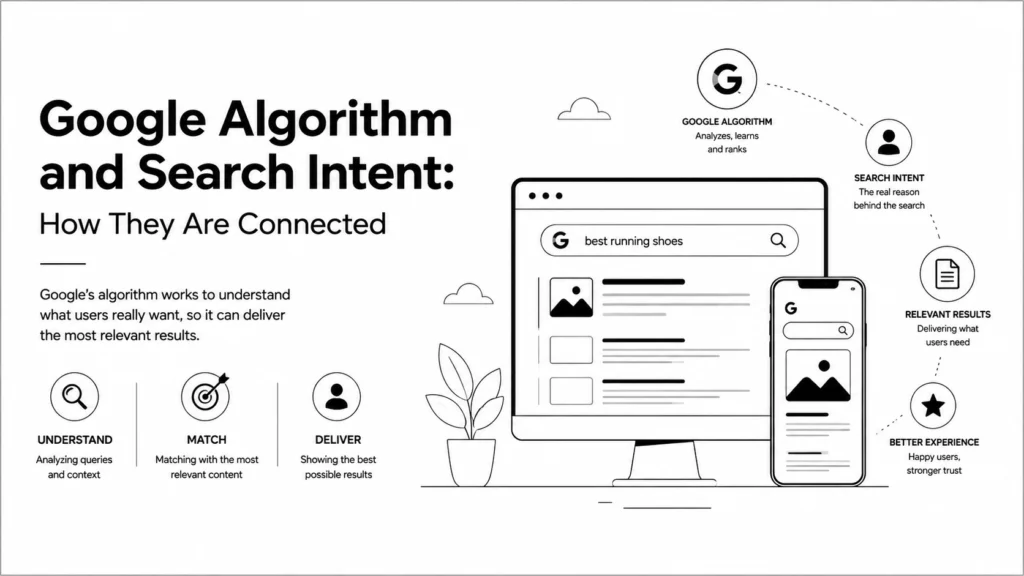
People typically have a definite objective in mind when they search on Google. They may want to learn something, compare products, visit a particular website, or complete an action. This goal is known as search intent. Understanding search intent is essential for creating content that satisfies readers and performs well in Google Search.
The Google algorithm does not rank pages only because they contain exact keywords. Google’s ranking systems analyze the meaning of a query, the relevance of a page, its quality, usability, and other contextual factors. For example, someone searching for “how to change laptop brightness” may find a page titled “how to adjust laptop brightness” because Google understands that both phrases describe a similar need.
This connection between the Google algorithm and search intent has changed the way content should be created. Instead of repeating keywords unnaturally, bloggers need to understand what users expect and provide the most useful answer in the right format.
- What Is Search Intent?
The motivation behind a user’s search query is known as search intent. It explains what the user hopes to find or accomplish after typing words into Google.
For example, consider these searches:
“What is digital marketing?” shows that the user wants information.
“Best laptops for students” shows that the user is comparing options.
“Buy running shoes online” shows that the user is ready to take action.
“Facebook login” shows that the user wants to reach a specific website.
Four categories are typically used to classify search intent:
Informational intent: The user’s goal is to get knowledge about a subject. Words like “what,” “why,” “how,” and “guide” are frequently used in searches.
Navigational intent: The user wants to visit a particular website, brand, or online platform.
Commercial investigation intent: The user is researching products, services, or solutions before making a decision.”Best smartphones under ₹30,000″ and “WordPress vs. Wix” are two examples.
Transactional intent: The user wants to complete an action, such as buying a product, booking a service, downloading a file, or signing up for an account.
A single keyword can sometimes have more than one possible meaning. Google must interpret the query and identify the most likely purpose before displaying results.
- How the Google Algorithm Understands Intent
The Google algorithm examines the words in a query, their relationship to one another, and the context surrounding them. Google’s systems are designed to understand meaning rather than simply match individual keywords.
Suppose a user searches for “apple nutrition.” The word “apple” could refer to the fruit or the technology company. However, the word “nutrition” gives Google an important clue that the user is probably looking for information about the fruit.
Google also considers the wording and structure of a query. Words such as “buy,” “price,” “near me,” “review,” “tutorial,” and “official” can reveal what the searcher wants. Location, language, device type, and settings may also influence the results shown to a particular user. Google explains that its Search systems use factors such as meaning, relevance, quality, usability, expertise, location, and settings when generating results.
The search results page itself provides useful evidence about intent. If the top results are mostly tutorials, Google may understand the query as informational. If the results contain product pages and shopping listings, the query may have commercial or transactional intent.
For bloggers, this means that keyword research should go beyond search volume. You should also study the type of content Google already considers suitable for that query.
- Why Search Intent Matters for Rankings
A blog post can contain the right keywords and still fail to rank if it does not satisfy the searcher’s real purpose. This happens when there is a mismatch between the keyword and the content.
For example, imagine a user searches for “best budget smartphones.” They are probably expecting comparisons, specifications, advantages, disadvantages, and recommendations. If your page only provides a general definition of smartphones, it may not satisfy the user. Even if the keyword appears several times, the content does not match the expected intent.
In a similar vein, a person who searches for “how to create a blog” probably wants a detailed tutorial.. A short sales page for web hosting may not provide enough practical information. On the other hand, a person searching for “buy web hosting” may prefer a product or pricing page rather than a long educational article.
Matching search intent can improve the usefulness of a page in several ways:
It gives readers the information they expected.
It helps you choose the correct content format.
It improves the relevance of your title and headings.
It makes the article easier to navigate.
It increases the chance that readers will continue exploring your website.
Google’s ranking systems aim to show useful and relevant information for users’ queries, so intent alignment is a central part of effective SEO.
- How to Match Content with Search Intent
The first step is to search your target keyword on Google and examine the current results. Look at the titles, page types, headings, featured snippets, videos, product listings, and related questions.
Next, identify the dominant intent. If most results are detailed guides, create a guide. If most results are comparison pages, prepare a comparison. If product pages dominate the results, an informational blog post may not be the best format for that keyword.
You should also use intent-specific language in your content:
For informational topics, use phrases such as “complete guide,” “explained,” and “step-by-step.”
For comparison topics, use words such as “best,” “top,” “comparison,” and “alternatives.”
For transactional topics, include “buy,” “pricing,” “discount,” “order,” or “book” where appropriate.
For navigational topics, clearly mention the brand, website, or official page.
The structure of the content should also support the reader’s goal. A tutorial should contain clear steps. A product comparison should include consistent evaluation criteria. An informational article should answer the main question early and then provide supporting details.
Avoid forcing a keyword into every paragraph. Use related terms, examples, questions, and natural language.
- Common Search Intent Mistakes to Avoid
One common mistake is creating content based only on keyword volume. A popular keyword may attract many searches, but it may not be suitable for your website or content format.
Targeting a commercial keyword with an entirely informative content is another error. A page titled “What Is Website Hosting?” might not be able to effectively contend for the title of “best website hosting for small business.” The first question asks for an explanation, but the second asks for recommendations.
Some bloggers also use misleading titles. A comprehensive tutorial may be promised in the headline, but the page may just provide a brief synopsis. This creates a poor experience and makes it less likely that readers will find the content useful.
Other mistakes include:
Ignoring the questions users ask in related searches.
Writing a long introduction before answering the main query.
Using a product-focused page for an educational keyword.
Copying competing articles without adding original value.
Failing to update information when the topic changes.
Optimizing for several unrelated intents on one page.
The best approach is to select one primary intent for each article. You may address related questions, but the page should have a clear purpose.
Frequently Asked Questions
- Does Google use search intent as a ranking factor?
Google does not usually describe search intent as one isolated ranking factor. However, understanding the meaning and purpose behind a query is an important part of how Google Search provides relevant results.Content is more likely to be competitive if it clearly meets the needs of the user. - Can one keyword have multiple search intents?
Yes. Some keywords are ambiguous or broad. For example, “Java” might refer to the programming language, the Indonesian island, or coffee. Google uses context and other signals to determine the most likely interpretation and may display different types of results. - How can I identify the intent of a keyword?
Search the keyword on Google and study the first-page results. Check whether they are guides, product pages, reviews, category pages, videos, or official websites. The dominant result type usually indicates the primary search intent. - Should I use the exact keyword throughout my article?
No. Use the keyword naturally in important areas such as the title, introduction, headings, and relevant body sections. Include related phrases where they improve clarity, but avoid keyword stuffing. - Can search intent change over time?
Yes. User expectations and search results can change. A query that once produced mostly blog posts may later show videos, product listings, local businesses, or AI-generated search features. Review important keywords regularly and update your content when the dominant intent changes.
Conclusion
The Google algorithm and search intent are closely connected because Google’s primary task is to understand what users want and present relevant, useful results. Successful blogging therefore requires more than choosing keywords and inserting them into an article.
Before writing, identify the searcher’s goal, study the current results, and select a content format that matches that goal.Next, produce material that addresses the primary question in a clear, accurate, and helpful manner without needless keyword repetition. When your blog consistently meets user expectations, it becomes more relevant to readers and better aligned with how Google Search evaluates content.